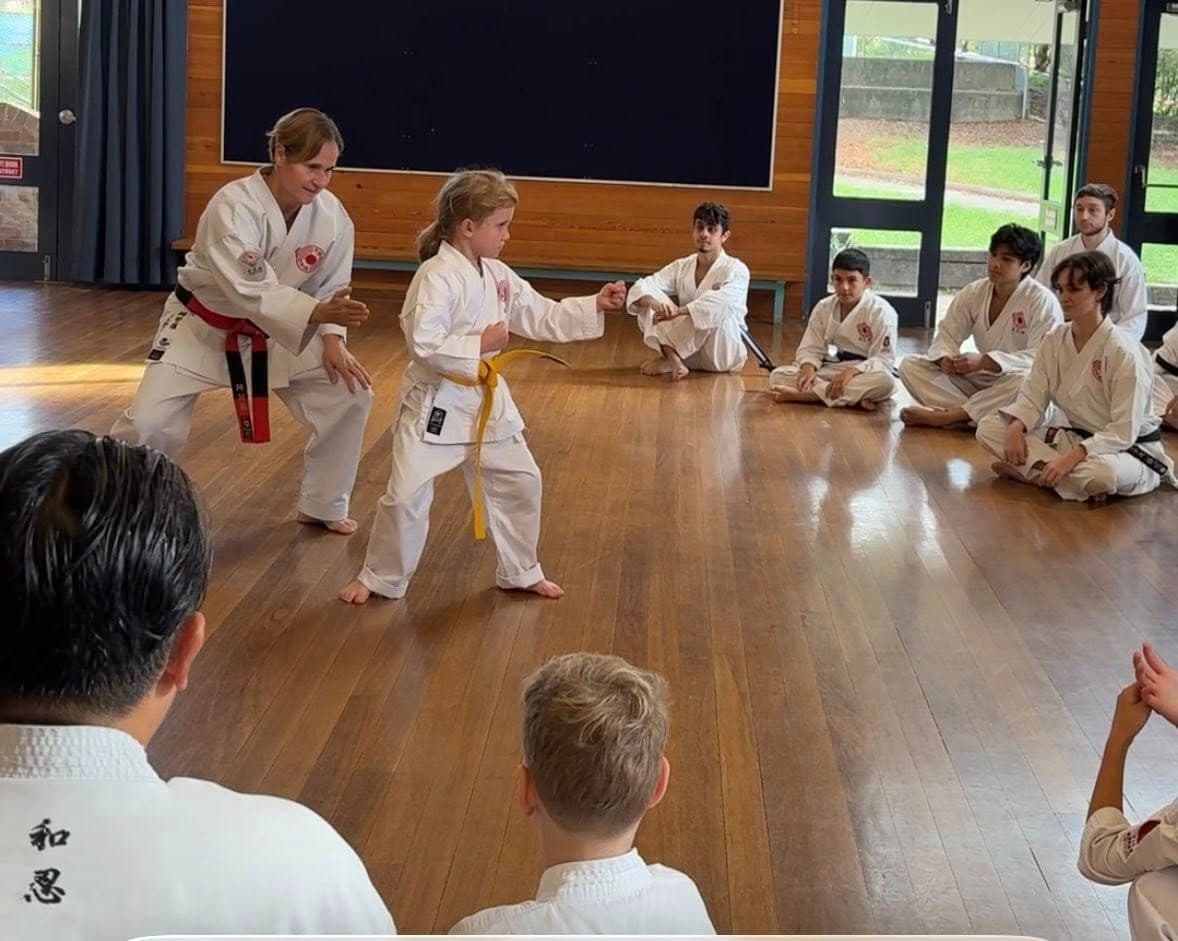
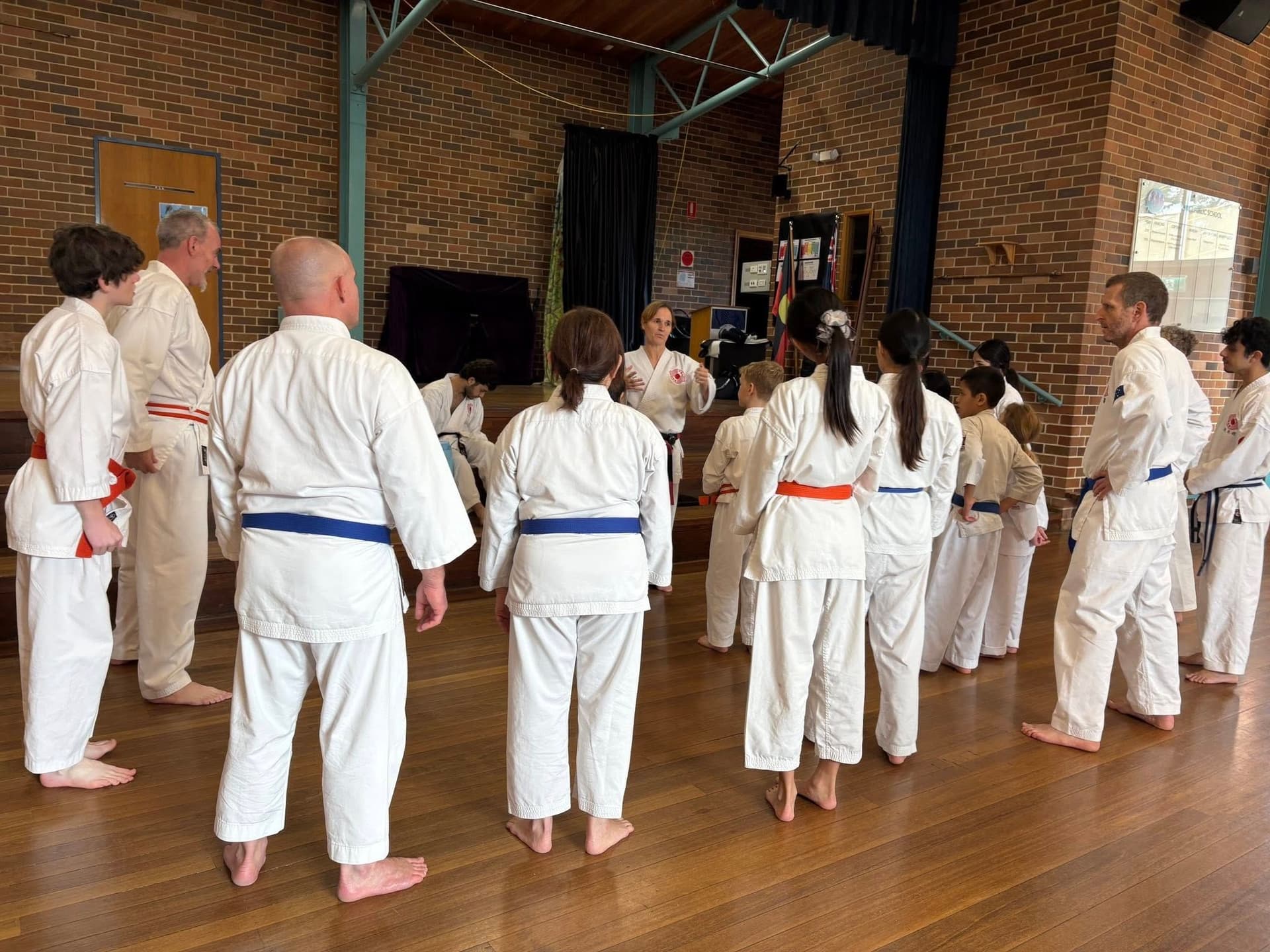
A four-year-old steps onto the mat for the first time, watches the older students bow, and copies them half a second too late. It is a small moment, easy to miss if you are watching from the viewing area with a coffee in hand. But it is also the same gesture students have made at the start of class for hundreds of years, in a tradition that stretches back further still.
Most parents who walk through our doors know karate involves kicks, punches and belts. Fewer know where any of it came from, or why a bow at the start of class matters at all. Understanding that history does not change what happens on the mat. It changes how you see it.
Where Karate Began — Okinawa, Not Japan
Karate did not begin in Japan, and it did not begin with punches and kicks either. One popular legend traces its roots back roughly 1,500 years, to teachings attributed to the Indian Buddhist monk Bodhidharma — though most historians treat that link as a 20th-century story rather than verified history. What we do know for certain is more local: in 1372, Ming Dynasty trade routes carried Chinese martial arts influence to the small island kingdom of Okinawa.
There, a class of officials and scholars known as the Pechin developed their own hand-fighting methods, simply called “te” — Okinawan for “hand”. In 1609, an invading clan banned weapons across Okinawa. Rather than disappear, fighting skill moved into empty hands, refined quietly, passed from teacher to a small number of students.
Three towns ended up doing this differently enough that each produced its own flavour: Shuri, Tomari and Naha. Shuri-te, Tomari-te and Naha-te were not yet called karate. But they were its direct ancestors, and the differences between them are still visible in the styles taught around the world today, including in ours.
How Karate Came to Japan — The Story of Funakoshi
The line from that early Okinawan te to the karate taught in dojos today runs through a short chain of teachers: Sakukawa Kanga taught Matsumura Sokon, who taught Itosu Anko, who taught a schoolteacher named Gichin Funakoshi.
In 1917, Funakoshi gave his first public demonstration of Okinawan karate in mainland Japan, at the Butokuden in Kyoto. It was a smaller, modest affair. The turning point came in 1921, when he demonstrated at Shuri Castle in Okinawa for the Crown Prince — later Emperor Hirohito — who was passing through on his way to Europe, and was visibly impressed. The following year, in 1922, Dr Jigoro Kano, founder of Judo, invited Funakoshi to demonstrate at the Kodokan, Judo's home dojo, and then backed his decision to stay in Japan and keep teaching.
That single act of support is easy to skip over, but it mattered. Without Kano's backing, karate may never have taken hold in Japan at all, let alone spread to the rest of the world. Funakoshi went on to found Shotokan, the style most people picture when they hear the word karate. Every dojo teaching karate in Australia today, including ours, sits somewhere on that same lineage.
The Different Styles — Why They All Look Slightly Different
From Funakoshi's generation on, karate split into several major styles, each shaped by its own founder. Shotokan, developed by Funakoshi himself, traces to the dojo he opened in Tokyo in 1936, and went on to become the most widely practised style in the world after the Second World War. Goju-ryu, founded by Chojun Miyagi, blends hard and soft technique within the same system. Shito-ryu, created by Kenwa Mabuni, combines elements of both Shuri-te and Naha-te. Wado-ryu, founded by Hironori Otsuka — one of Funakoshi's own students — in the late 1930s, leans on joint locks and evasive footwork. Kyokushin, founded by Masutatsu Oyama and named in a 1957 ceremony, became the foundation for many of the full-contact federations practised today. And in 1946, Tsuyoshi Chitose founded Chito-Ryu, drawing on both Shorin-ryu and Naha-te traditions — the style taught at every class here at The Karate Institute.

What This Means for Your Child Today
None of this changes what your child does in class on a Tuesday afternoon. But it does change what it means. When a child bows at the start of a lesson, says “oss”, or works through a kata they have practised a dozen times, they are taking part in something with real depth behind it — not a marketing exercise, but a living tradition with roots in Okinawa and a clear line through to today.
Our Little Dragons program, for children aged four to seven, is built as the entry point into that lineage. It is not about handing a four-year-old a tradition they cannot yet understand. It is about giving them access to something real, with room to grow into it over years, not weeks. Sensei Noonan's training and lineage sit behind every class we run, including the very first one your child will ever attend.
See what your child's first lesson looks like
If you'd like to see what your child's first lesson looks like, we offer a free trial class at our Peakhurst and surrounding suburb locations.